
Morgan County Release Date Meaning
A projected date is a current calculation, not a promise of physical release. IDOC uses two exact labels. “Projected Parole Date” usually estimates when a person with a modern determinate sentence may leave prison for parole or mandatory supervised release. “Projected Discharge Date” estimates when the full IDOC sentence and supervision end. A profile may also show “Last Paroled Date” and “Sentence Discharged?: YES/NO.” Copy each label exactly. Combining them into one generic release date hides the stage of the sentence.
An actual release is the completed custody event. The agency record should show whether the person entered the community, began parole or MSR, transferred to another facility, or went to another authority. A Morgan County Jail record can document the date, time, and authority for release, discharge, or transfer. A court order provides the legal basis, but the order date is not necessarily the jail exit time. For Jacksonville Correctional Center, the IDOC status and release record control the prison event.
Find Morgan County Projected Dates
Begin by deciding whether the person is a county detainee, a person serving a county sentence, or an IDOC prisoner. IDOC's public search is not a county-jail release calculator. Morgan County also publishes no jail roster or online release-date field. For a pretrial booking, the court may order release, yet the jail must still complete identity, property, hold, and departure processing. There is no fixed sentence-based date while the case remains pretrial.
- Identify the last verified custodian and collect the booking number, IDOC number, full name, and birth date when known.
- For IDOC, open the Individual in Custody Search and search by last name, IDOC number, or birth date.
- Match the result through the number, full identity, physical details, parent institution, status, and location.
- Write down Projected Parole Date and Projected Discharge Date separately, along with the retrieval date.
- Read each sentencing block for offense, county, custody date, imposed sentence, mittimus, and discharged flag.
- Obtain the sentencing order from the Morgan County Circuit Clerk when the calculation needs context.
- For a county sentence, request the Sheriff's calculation record and custody credit. Do not apply IDOC percentages.
If a fully completed state sentence no longer appears, use IDOC Contact Us and choose “Record Search.” Supply the full name, date of birth, IDOC number if known, receipt year, facility, conviction county, and key dates. A live-search no-result does not prove that no IDOC record exists.
Morgan County IDOC Date Fields
The public result is called “Internet Inmate Status.” It can show the parent institution, offender status, location, a photograph, physical details, and an Admission/Release/Discharge block. Sentencing blocks may show the mittimus, count, class, offense, sentence, county, custody date, and whether that sentence is discharged. Those fields help check identity and explain why two projected dates appear.
| IDOC field | What it means |
|---|---|
| Projected Parole Date | Current estimate for prison exit into parole or MSR in the usual modern sentence path |
| Last Paroled Date | A prior date the record identifies as a parole event |
| Projected Discharge Date | Current estimate for the end of the IDOC sentence and supervision |
| Offender Status / Location | Whether the person is shown in prison, on parole, or another displayed category |
| Sentence Discharged? | Whether the listed sentencing block has ended |
IDOC says its live search displays disclosable information for people now incarcerated or on parole. Once the sentence is complete, the profile is removed from the live result. Archived Record Search is therefore part of a sound Morgan County release date lookup, especially when checking a past Jacksonville Correctional Center case.
Morgan County Sentence Credit Rules
Illinois sentence credit cannot be reduced to “everyone serves 85 percent.” The governing law, 730 ILCS 5/3-6-3, contains rules tied to the offense, offense date, sentence date, and statutory subsection. IDOC's directive defines Statutory Sentence Credit as the required share of a determinate sentence, which can be 50, 75, 85, or 100 percent. It separately defines Earned Program Sentence Credit. “Statutory Good Time” is a term for old indeterminate sentences, so the broad phrase “good time” can obscure the actual credit category.
Some specified earned or program credits may apply to people otherwise under listed truth-in-sentencing rules, subject to statutory floors. The research identifies floors that do not allow confinement below 85 percent where the base rule is 85 percent, below 60 percent for a rule of 75 percent, with the gunrunning exception remaining at least 75 percent, or below 100 percent where the rule requires 100 percent. The current statute and the exact conviction control. Eligibility never guarantees an award.
The official statute page is reproduced in the matching manifest image below, linked from the Illinois General Assembly sentence-credit text.
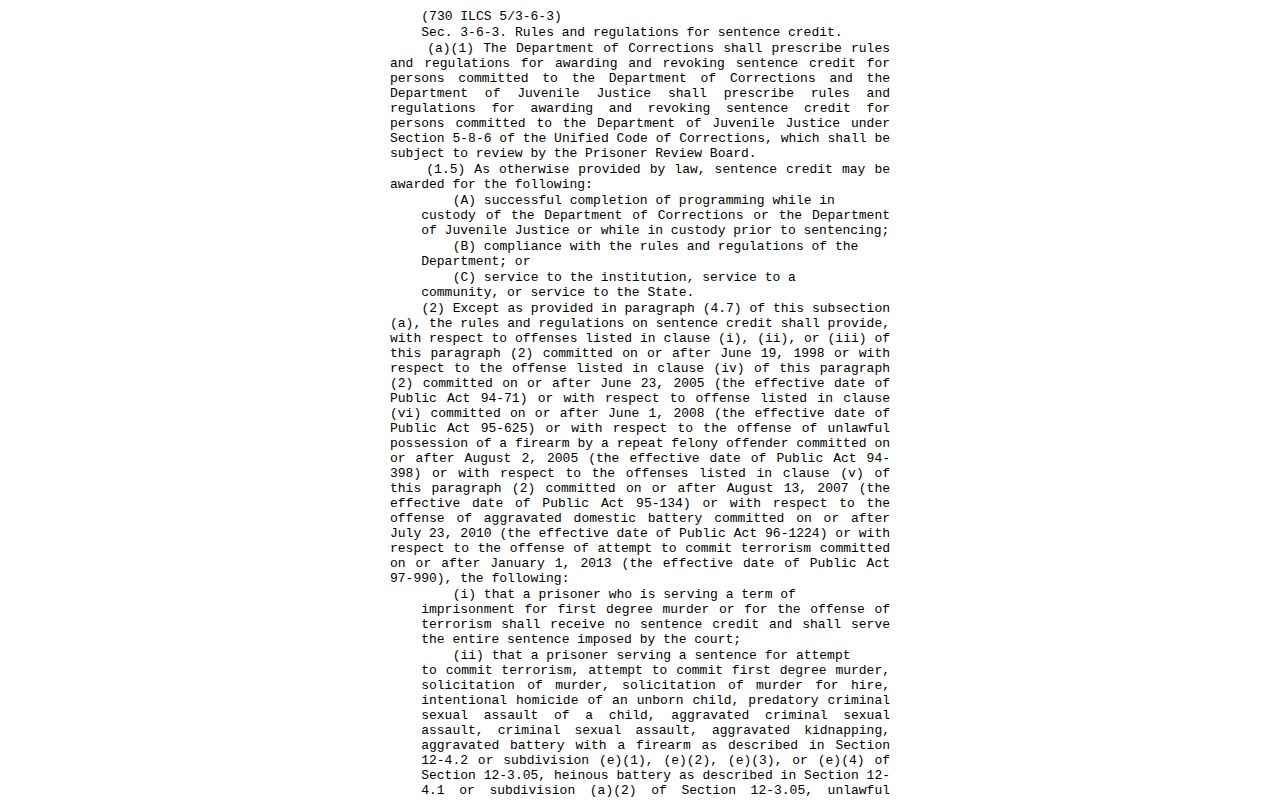
The source demonstrates why a percentage must be traced to the offense and subsection rather than guessed from a broad truth-in-sentencing phrase.
Morgan County Date Calculation
IDOC directive 01.07.400 calls for determinate calculations of projected parole or release and mandatory-supervised-release dates. Conceptually, records staff determine the custody intervals eligible for credit, account for release on bond, find the adjusted custody date, apply the sentence and lawful credits, and calculate the mandatory-out stage separately. Two Records Office staff ordinarily review the calculation, apart from a narrow immediate-release exception.
Concurrent sentences run at the same time, while consecutive sentences run one after another. A mittimus is the court document that commits a person and states the sentence. Extra mittimuses, another jurisdiction's sentence, or credit already applied elsewhere can change the computation. IDOC, not Jacksonville Correctional Center program staff, maintains the sentence calculation and decides discretionary credit awards under the controlling rules.
IDOC states that an Earned Sentence Credit award which revises the Projected Parole Date will appear on the profile. The agency also says it cannot predict whether a particular person will get a discretionary award because the review uses confidential master-record information. Explain the rules, but do not forecast an award.
Morgan County Release Date Changes
Projected dates move when the records behind the calculation move. Some changes shorten the estimate, while others lengthen it or change which custodian controls the next step. A detainer is a request or legal basis for another authority to take custody. Thus a person can leave IDOC on the displayed date yet not enter the community.
| Change driver | Possible effect |
|---|---|
| Verified county jail credit | Adjusts credit for an eligible pre-sentence custody period |
| Bond-release intervals | Breaks continuous custody and affects eligible dates |
| Concurrent or consecutive terms | Changes how multiple sentences combine |
| New or corrected mittimus | Requires recalculation from the court's controlling order |
| Earned credit award | May advance the projected parole date within statutory limits |
| Credit loss or restoration | Can move the estimate later or earlier |
| Parole/MSR violation | May return the person to custody and trigger recalculation |
| Detainer or other sovereign | Can turn a prison exit into a transfer rather than community release |
Administrative corrections and qualifying changes in law can also require a new date. Illinois law ordinarily calls for advance notice to specified prosecuting and release-county officials when earned credit advances release. That notice is not a promised public update schedule. Record the date a profile was viewed and check again near the expected event.
Morgan County Jail Release Dates
No Morgan County ordinance, Sheriff rule, or court policy establishing a local jail good-time formula was found. A person serving only a county sentence should not be assigned IDOC's projected fields or a prison truth-in-sentencing percentage. Request the sentencing order, the jail's calculation record, and all credited custody dates. If the person later transfers to IDOC, state corrections then performs the prison calculation.
Pretrial detainees pose a different issue. They have not received a sentence-based release date. The court docket may show a release order, bond action where applicable, dismissal, or later hearing. The Morgan County Jail record supplies the completed departure date, time, and authority under the Illinois jail rule. It should also distinguish community release from transfer. The Morgan County release-record workflow explains how the court and jail records work together without turning the order time into an unsupported exit time.
Note: Morgan County publishes no online jail roster or release-date field, so direct Sheriff and court records are the local route.
Morgan County Projected Date Quirks
The main Illinois quirk is the pair of IDOC labels. Projected Parole Date and Projected Discharge Date describe different milestones. Truth in sentencing also spans several percentages rather than one universal 85-percent rule. Later earned credit can revise a displayed date. These points form the distinctive §19 release-date angle for Morgan County and make a screenshot or old note unsafe as a final answer.
A state-prison exit may lead to parole or MSR, another facility, or another authority. Final discharge may occur much later. A county-jail exit may likewise be a transfer to IDOC. Use the destination and status after the event to learn what happened. If a sentence block says “Sentence Discharged?: YES,” check whether other blocks remain active before concluding the entire case has ended.
Confirm Morgan County Release Dates
Near the projected date, recheck the IDOC profile and register for a specific-person Illinois VINE status alert. VINE can report a release, transfer, escape, or other event from a participating feed, but it is notification rather than a certified sentence calculation. The Morgan County VINE inmate check covers registration and the limits of those alerts. Confirm the exact event with IDOC or the Sheriff.
After prison exit, read the new offender status and location. Determine whether the person began parole or MSR, transferred, or reached final discharge. For a county booking, request the date, time, authority, type, and destination from the jail record. When a date appears wrong, obtain the mittimus and custody-credit record before asking IDOC Records or the Sheriff to review it. Clear labels make a correction request much easier to assess.